
Three ways to deal with hard water
Hard water is water that carries dissolved calcium and magnesium. When it dries on glass it leaves spots, and when it heats up it leaves scale inside pipes and heaters. Your water agency publishes a hardness number every year, and each city page shows it with a link to the report.
There are three ways to deal with it. Each one does a different job.
Salt-based softener (ion exchange)
A tank of resin beads holds sodium. As hard water flows through, calcium and magnesium stick to the beads and sodium goes into the water. When the beads are full, the system rinses itself with salt brine and sends that brine down your drain.
This removes hardness, as exchange tanks do and a salt-free conditioner does not. It does nothing for chlorine, chloramine or sediment.
California sets rules for any residential softener that regenerates at the home. It has to regenerate on demand rather than on a timer, carry a certified salt-efficiency rating, and be installed with water-saving devices, and the installation paperwork goes to the local permit agency. Some cities and sewer agencies go further and restrict or bar these units.
Salt-free conditioner
There is no salt, no brine and no discharge to the drain. A conditioner does not remove hardness. The minerals stay in the water, and the media changes how they form scale.
An independent study of salt-free alternatives, cosponsored by the U.S. Bureau of Reclamation and the California State Water Resources Control Board, compared three types in the lab. One type, template-assisted crystallization, cut scale formation by about 90 percent, close to what the salt softener in the same study did. The other two types cut it by roughly half. None of the three removed hardness. Which type is inside a product matters, so ask what the media is.
What a conditioner does not change is the look of your water. Expect spotting on glass and soap film on shower doors to continue, because the minerals are still there. Think of it as scale protection for pipes, heaters and fixtures.
Exchange tanks (off-site regeneration)
A service delivers tanks of softening resin and swaps them on a schedule. The tanks are regenerated at a separate facility, so no salt brine leaves your home. You get softened water with no brine going down your drain. California law allows it, and the Irvine Ranch Water District recommends an exchange service by name.
If your city restricts salt-based units and you want softened water, this is the route. Ask Nuvia what is available at your address.
Which cities restrict salt-based units
Some do, and the rules differ by street, because the agency that treats your sewage is not always the one that sells you water.
- Corona. A city permit is required for an on-site-regenerating unit.
- Redlands and the seven Inland Empire Utilities Agency cities (Chino, Chino Hills, Fontana, Montclair, Ontario, Rancho Cucamonga and Upland). New on-site-regenerating units are barred, and in the agency's cities so are replacements. Units already installed can stay.
- Irvine and the Irvine Ranch Water District area, which includes parts of Lake Forest, Tustin and Orange. Restricted or discouraged, depending on which page you read.
- Riverside and San Bernardino. Allowed under conditions, including a permit and an installation certificate.
- Anaheim. The city states it has no prohibition on salt-based systems.
Nuvia does not recommend a salt-based unit at an address where the city or sewer agency bars one. Rules change, so confirm yours with your city before you buy. City pages for Corona, Riverside, San Bernardino, Anaheim and Yorba Linda show each agency's published hardness and what applies there. The Orange County and Inland Empire pages list the rest.
Which Nuvia systems fit
Scale protection without salt
- Nuvia Advantage. Five-stage whole-home filtration with a scale stage.
- Nuvia Scale Shield. Two stages, sediment and scale control, listed at up to 40 gallons per minute.
- Nuvia Sentry. Sediment, a scale stage and a carbon block in one wall-mounted unit.
- Nuvia Thermo Guard. Scale protection built for tankless water heaters, gas or electric.
Softening, where a salt-based unit is allowed at your address
- Nuvia Simplicity. Softening with a sediment stage.
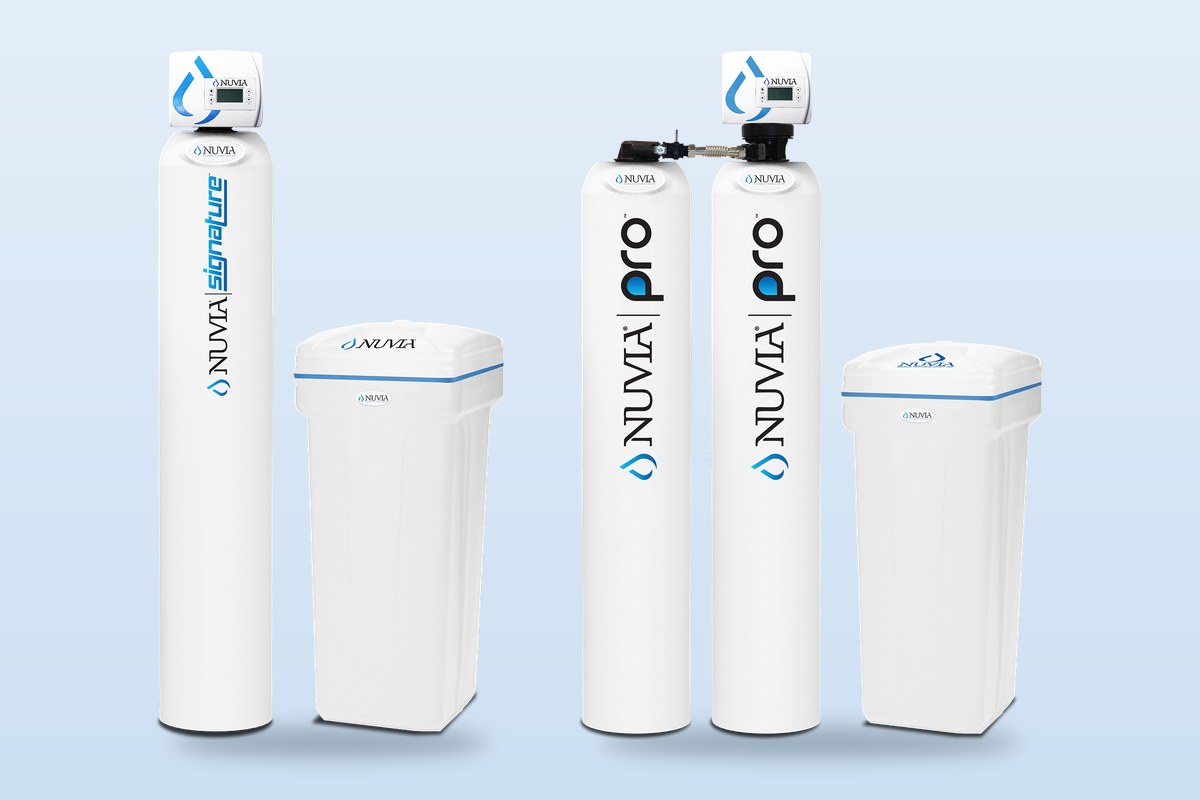
- Nuvia Pro. Two tanks: a filtration tank and a softening tank.
- Nuvia Signature. Filtration and softening in one system.
These three use Dynamic Regeneration, which sets the regeneration cycle by how much water the household uses instead of by the clock. Nuvia's softener models are listed by IAPMO R&T as certified to NSF/ANSI 44, the standard for softeners that reduce hardness.
What a softener does not do
A softener removes hardness. It does not remove chlorine, chloramine or sediment, and it is not a drinking-water system. For the water you drink and cook with, see reverse osmosis drinking water. For chlorine and sediment across the whole house, see whole-house water filtration.
Start with the free water analysis
The free water analysis is done at your tap. It looks at hardness, chlorine and total dissolved solids, and it is not a health screening. You see your hardness number before you pick an option.
Sources
- Evaluation of Alternatives to Domestic Ion Exchange Water Softeners (WateReuse Research Foundation WRRF-08-06, 2014)
- California Health and Safety Code 116775 to 116795, residential water softeners
- Corona Municipal Code, water softening appliances
- Inland Empire Utilities Agency, water softener rebate program and ordinance
- Irvine Ranch Water District, water quality information on softeners
- City of Riverside, residential water softener guidelines
- City of Anaheim, water hardness
- USGS, hardness of water
- IAPMO R&T certificate 19858 (file WP-11206, NSF/ANSI 44)
- Nuvia Pro, Signature, Simplicity, Advantage, Scale Shield, Sentry and Thermo Guard (live product pages)
Questions people ask
Do salt-free conditioners soften water?
No. A salt-free conditioner does not remove the hardness minerals. It changes how they form scale, so less builds up on pipes and heaters. The minerals stay in the water, so spots on glass and soap film on shower doors continue.
Which is better, a salt-based softener or a salt-free conditioner?
They do different jobs. A softener removes hardness, which is what stops the spots, the soap film and most of the scale. A salt-free conditioner protects against scale and nothing else. If your city bars salt-based units, a conditioner or an exchange service is the route.
Can I install a salt-based softener in my city?
It depends on your city and on the agency that treats your sewage, which is not always the agency that sells you water. Corona, Redlands and the Inland Empire Utilities Agency cities restrict or bar them, and Irvine and the Irvine Ranch Water District restrict or discourage them. Confirm your address with your city before you buy one.
Why can a salt-free conditioner not be certified to NSF/ANSI 44?
NSF/ANSI 44 certifies that a softener reduces hardness. A salt-free conditioner does not remove hardness, so it cannot meet that standard. That does not make it a bad product for scale. It makes it a different product.
Does a softener remove chlorine or chloramine?
No. A softener removes hardness and does nothing about chlorine, chloramine or sediment. That is why Nuvia Pro and Nuvia Signature pair softening with a filtration stage, and why a carbon filter is a separate purchase on a stand-alone softener.
What is exchange-tank service?
A service delivers tanks of softening resin and swaps them on a schedule. The tanks are regenerated at a separate facility, so no salt brine leaves your home. California allows it, and it is the option water agencies point to where self-regenerating units are restricted.
Book your free water analysis today.
A Nuvia specialist tests your water at your tap and shows you the numbers.