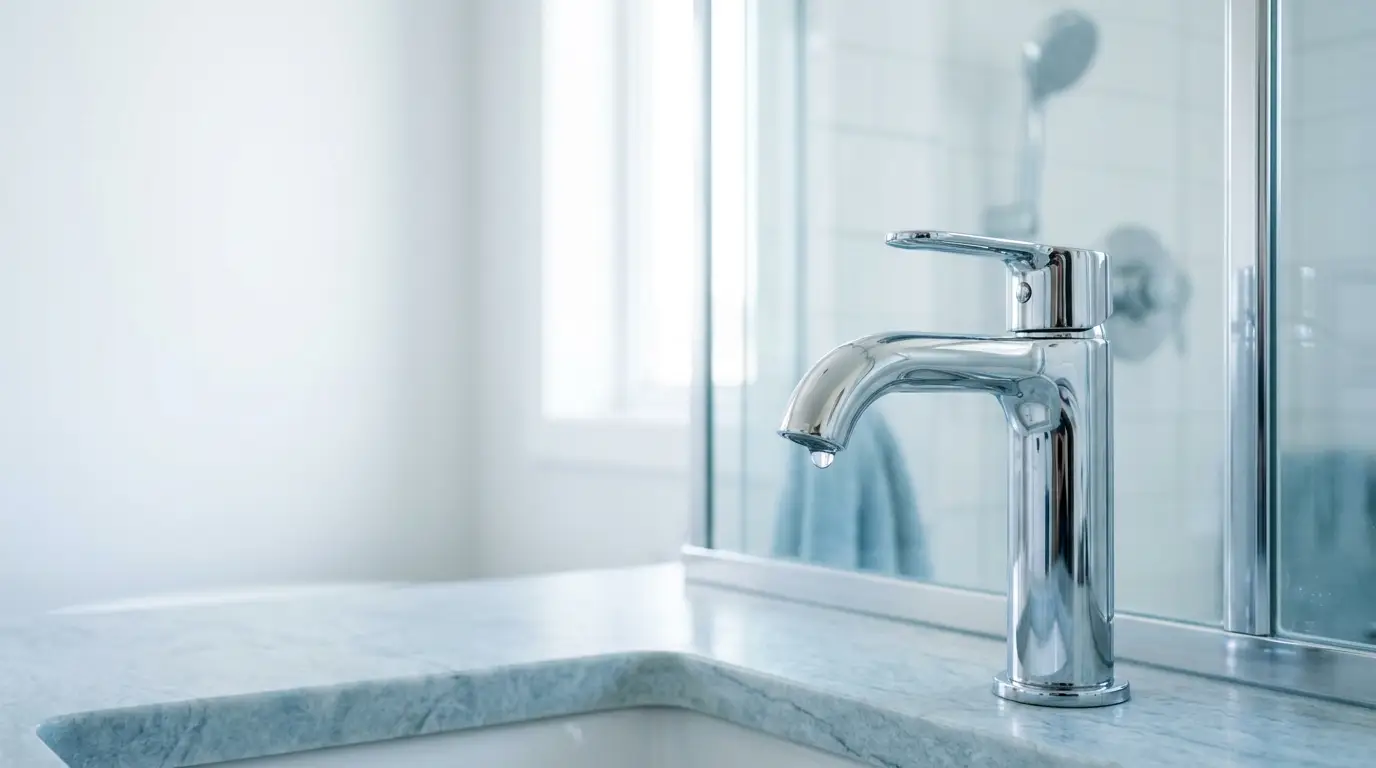

Why the spots come back
Hard water carries dissolved calcium and magnesium. When a drop of it dries on glass, steel or tile, the water leaves and the minerals stay. That is the spot. The U.S. Geological Survey lists spots and film on glassware as a common sign of hard water, and it notes that heating the water leaves scale behind as well.
Every shower, every dishwasher cycle and every rinse of a faucet adds a little more. Wiping clears the layer that is there. It does not change what the next drop leaves.
What the white residue is
- Mineral spots and film. Calcium and magnesium left behind when water dries. Dishwasher makers describe white film on glassware and on the inside of the machine as mineral build-up, most often in hard water areas.
- Soap film. The USGS says soap reacts with the calcium in hard water to form soap scum. That is the cloudy film on shower doors and tubs.
- Detergent film. Not everything white is hardness. GE's support page says phosphate-free dishwasher detergent can leave a milky film on glassware too, and that it is most often seen where the water is hard. So the film on your glasses can have two causes at once.
- Etching. Deposits left long enough can change the glass surface itself. Two glass-restoration companies describe it as a rough, hazy surface that cleaning does not remove. Spots wipe off. Etching does not.
What helps
- Dry glass and fixtures after use. A spot is a drying drop. Wiping a shower door or faucet dry before the water evaporates leaves nothing to spot.
- Use the dishwasher's own settings. Dishwasher makers publish steps for white film: a rinse aid, a vinegar rinse, a citric acid cycle or a dishwasher descaler. Bosch's manual says to set the rinse aid by your water hardness, and Bosch recommends its descaler a few times a year to remove hard water deposits and limescale.
- Check the finish before you reach for a descaler. Kohler's warranty lists acids among the cleaners that void it. Moen's excludes damage from abrasives, alcohol and organic solvents. A descaler that clears the crust can damage the faucet, so read the care instructions for your finish first.
- Treat the water, if you want the cause gone. A water softener removes the hardness minerals, so there is less to dry on the glass. It is not allowed everywhere. Some cities and sewer agencies restrict salt-based units, and your options depend on your address. See water softeners and conditioners and the city pages.
What does not fix spots
- More cleaning. It keeps the surface clear for a day. It does not change the water.
- A salt-free conditioner. It changes how minerals form scale, so there is less build-up inside pipes and heaters. The minerals stay in the water, so spots on glass and film on shower doors continue. See salt-free water conditioners.
- A carbon or sediment filter. These take out chlorine, taste, smell and particles. They do not remove hardness. See whole-house water filtration.
- A drinking-water system at one tap. A reverse osmosis system treats the water at the tap it is installed on. It does nothing for the shower door or the other faucets.
Start with the free water analysis
Before you pick a fix, find out how hard your water is. The free water analysis is done at your tap. It looks at hardness, chlorine and total dissolved solids, and it is not a health screening. You see your numbers first, then you decide.
Sources
- USGS Water Science School: Hardness of water (calcium and magnesium, soap scum, spots and film on glassware, scale)
- GE Appliances support: White film on glassware, dishware and the dishwasher interior
- Whirlpool product help: Spotting or filming on glassware
- Bosch Home US: How to clean and descale Bosch dishwashers
- Kohler faucet limited warranty (form 1353511-12)
- Moen limited warranty information (BMF2433)
- Capistrano Valley Glass & Mirror: How to restore scratched shower glass (hard water etching)
- Clear View Surface Solutions: Glass restoration (deposits that etch into glass)
Questions people ask
Why do I get spots even after I wipe everything down?
Wiping removes what is on the surface now. The next time water lands on the glass or the faucet and dries, it leaves a new layer of minerals. The only way to stop the spots at the source is to change the water, not the cleaning.
Is the white film in my dishwasher always hard water?
Not always. GE's support page says a milky white film on glassware can also come from phosphate-free dishwasher detergent, and that it shows up most often in hard water areas. If the film is only on dishes, try a different detergent and a rinse aid before you decide the water is the whole story.
Will a salt-free conditioner stop the spots?
No. A salt-free conditioner changes how hardness minerals form scale. The minerals stay in the water, so water that dries on glass still leaves them behind. It protects pipes, heaters and fixtures from scale. It is not a spot fix.
Can cloudy glass be cleaned back to clear?
Spots and film usually wipe or soak off. Etching does not. Two glass-restoration companies describe etching as a change to the glass surface itself, which is polished out or the panel is replaced. Etching is the reason not to leave deposits on glass for years.
Will vinegar or a descaler damage my faucets?
It can. Kohler's warranty says cleaners with acids, abrasives, ammonia, bleach and several other ingredients void the warranty. Moen's warranty excludes damage from cleaners with abrasives, alcohol or organic solvents. Read the care instructions for your finish before you use any descaler.
How do I know if hard water is my problem?
Your water agency publishes a citywide hardness number each year, and you can find yours on the hard water by city page. The free water analysis measures the water at your own tap.
Book your free water analysis today.
A Nuvia specialist tests your water at your tap and shows you the numbers.