
What a whole-house filter does
A whole-house filter is installed on the main water line where water enters your home. Every faucet, shower, washing machine and water heater downstream gets the treated water. Inside, the water passes through stages, and each stage has one job.
- Sediment stage. Catches sand, silt, rust and other particles. The Sentry, Scale Shield and Thermo Guard list their sediment stage at 5 microns.
- Carbon stage. Holds back chlorine as the water flows through. This is what takes the pool smell out of a shower and the flat taste out of a glass of tap water.
- Scale stage (some systems). A salt-free media that changes how hardness minerals behave, so less scale sticks to pipes, fixtures and heaters. The minerals stay in the water.
- Backwash or self-cleaning (some systems). The Carbon CRS and the Advantage reverse the flow on a program to rinse their media. The Filtro flushes trapped sediment on its own.
Chlorine, chloramine and why the carbon matters
Water agencies disinfect with chlorine or with chloramine, a chlorine and ammonia compound that lasts longer in the pipes. Chloramine is harder to remove. It takes carbon made for the job, called catalytic carbon, and enough contact time with the water. The Metropolitan Water District's wholesale supply and several South Orange County agencies use chloramine. Your agency's annual water quality report says which one it uses.
Nuvia lists chlorine and chloramine reduction for the Carbon CRS and the Advantage, and chlorine, taste and odor for the Sentry. Ask which carbon is in any system before you buy it.
Which Nuvia system fits
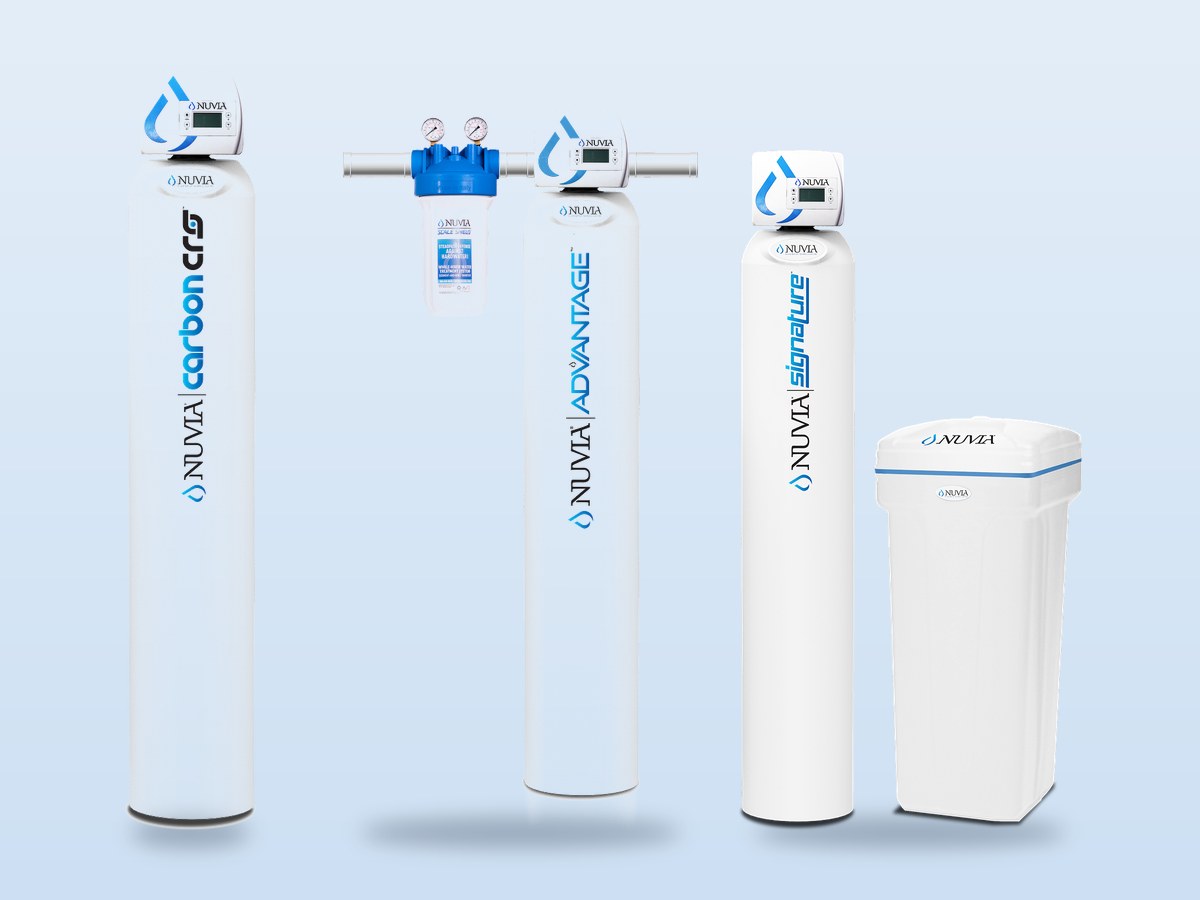
- Nuvia Carbon CRS. Three stages: sediment, carbon, and a final clarification stage, with a programmed backwash. No salt. The one to look at when chlorine taste and smell is the problem.
- Nuvia Advantage. Five stages, the same carbon work plus a scale stage. No salt. For homes that want chlorine reduction and scale protection together.
- Nuvia Sentry. A wall-mounted unit with a sediment stage, a scale stage and a coconut-shell carbon block, listed at up to 40 gallons per minute. Its page lists chlorine, taste and odor, not chloramine.
- Nuvia Filtro. A self-cleaning sediment filter, listed at up to 28 gallons per minute. For sand, rust and particles. Other filtration stages can be added to it.
- Nuvia Signature and Nuvia Pro. Filtration and softening in one system. Both use salt, so whether one is available depends on your address. See water softeners and conditioners.
If you have hard water and want the minerals gone, a filter alone will not do it. Check your city's published number on the hard water by city page.
What a whole-house filter does not do
- It does not remove hardness. A salt-free scale stage changes how scale forms, but the hardness minerals stay in the water. Spots on glass and soap film on shower doors are what a softener addresses.
- It does not give you reverse osmosis water. Carbon filters do not take out dissolved minerals. For the water you drink and cook with, see reverse osmosis drinking water.
- It is not a health product. These systems are sold for taste, odor, sediment and scale. We do not make health claims about them.
- It does not run forever. Media and cartridges wear out. The schedule depends on the system and your water.
Start with the free water analysis
The free water analysis is done at your tap. It looks at hardness, chlorine and total dissolved solids, and it is not a health screening. You see the numbers first, then you pick a system that fits them.
Sources
- Nuvia Carbon CRS (live product page)
- Nuvia Advantage (live product page)
- Nuvia Sentry (live product page)
- Nuvia Filtro (live product page)
- Nuvia Signature and Nuvia Pro (live product pages)
- Metropolitan Water District of Southern California, Water Quality Report (disinfectant)
- Irvine Ranch Water District, Water Quality Report (disinfectant)
Questions people ask
Do I need a whole-house water filter?
It depends on what bothers you. If it is the chlorine smell in the shower, the flat taste at every tap, or sand and rust in the water, a whole-house system addresses that. If you only care about the water you drink and cook with, a reverse osmosis system at the kitchen sink may be all you need.
Is a whole-house filter the same as a water softener?
No. A filter takes out sediment and chlorine. A softener removes the hardness minerals that leave spots on glass and scale on fixtures. Much of Orange County and the Inland Empire has hard water, and each city page shows its agency's published number. Nuvia Pro and Nuvia Signature put filtration and softening in one system where a salt-based unit is allowed at your address.
Does a whole-house filter remove chloramine?
Only carbon made for it does, and only with enough contact time with the water. Nuvia lists chloramine reduction for the Carbon CRS and the Advantage. Ask for the type of carbon in writing before you buy any system, ours or anyone else's.
Will a whole-house filter lower my water pressure?
Every filter adds some resistance. Sizing the system to your home's flow rate is how pressure is protected, and each product page lists the system's maximum flow. The Sentry is listed at up to 40 gallons per minute and the Filtro at up to 28.
How often do the filters need changing?
It depends on the system and on your water, so the schedule differs by model. Get it in writing for the exact system you are quoted. When you need replacement filters, order them from the customer support page.
What does "certified to NSF/ANSI 42" mean?
NSF/ANSI 42 is a standard for taste, odor, chlorine and particles. It is an aesthetic standard, so it makes no health claim. Certification is listed by model, and a "tested to" claim is not the same thing, so check the certifier's listing for the exact model number.
Book your free water analysis today.
A Nuvia specialist tests your water at your tap and shows you the numbers.