
How reverse osmosis works
Water pressure pushes tap water through a membrane with pores far smaller than a particle of dirt. Water gets through. Dissolved minerals and salts mostly do not, and they rinse away down the drain. That is why reverse osmosis water tastes different from tap water.
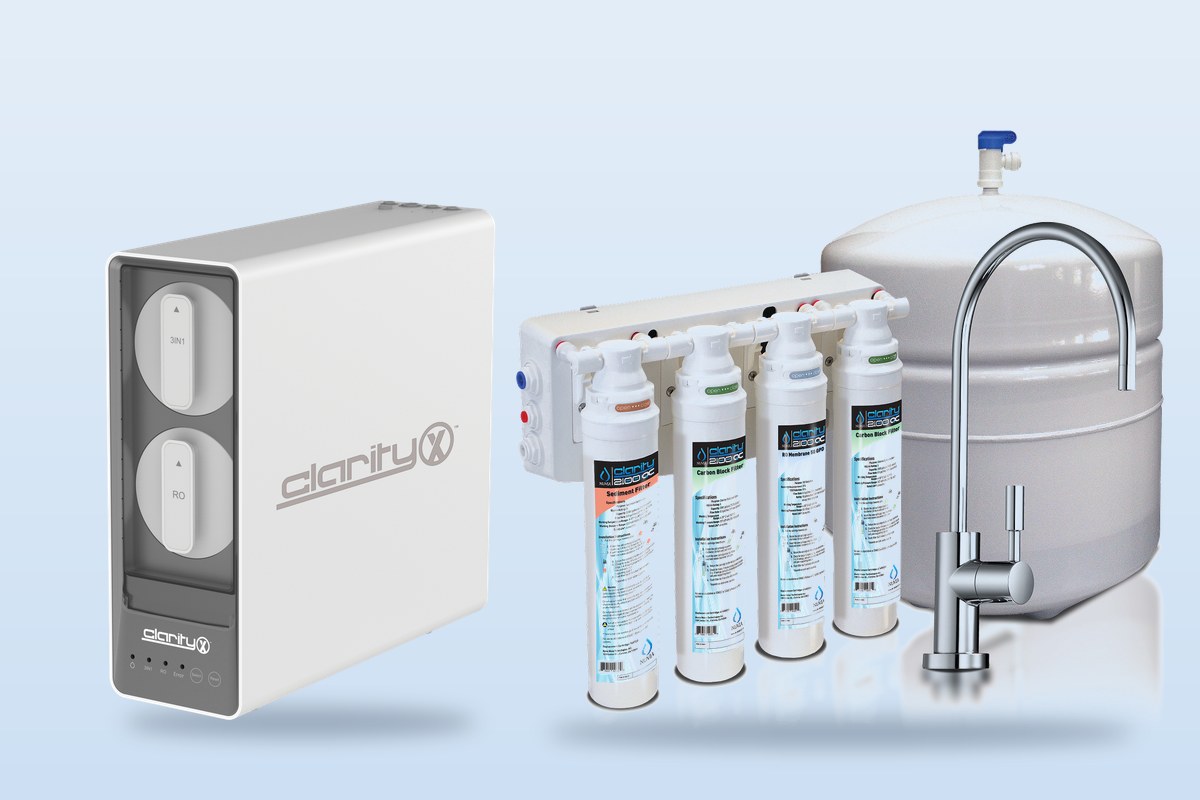
The Nuvia systems put the membrane between filters:
- Sediment filter. Catches particles so they do not clog the membrane.
- Carbon filter. Takes out chlorine, taste and odor. The membrane needs this step.
- Reverse osmosis membrane. Holds back dissolved minerals and salts.
- Carbon polish. A last carbon stage so the water tastes fresh at the faucet.
The Clarity Oasis has a fifth stage, a second pre-carbon filter.
Which Nuvia system fits
- Nuvia ClarityX. A tankless system for under the sink. It uses an 800 gallons-per-day membrane, quick-change filters, filter-life indicator lights and a leak shut-off that sounds an alarm.
- Nuvia Clarity Oasis. Five stages with quick-change filters. The alkaline filter is optional.
- Nuvia Clarity 2100 QC. A compact four-stage system with quick-change filters, built for the kitchen tap. The alkaline filter is optional.
- Nuvia Hydro Guard. A simpler option that is a filter, not reverse osmosis. Two stages under the sink, sediment and a carbon stage for chlorine, taste and odor. It does not hold back dissolved minerals.
- Nuvia Summit Alkaline. An optional add-on filter that adds minerals back after the membrane and raises the pH. Nuvia lists a pH of up to 9.5.
If you only want better taste in the shower and at every tap, look at whole-house water filtration first. Reverse osmosis is for the water you drink, cook with and make ice from.
What reverse osmosis does not do
- It does not treat the whole house. A membrane makes water slowly compared with what a shower or a washing machine uses. That is why it serves one tap.
- It does not soften the rest of your water. Hardness is still in the water at every other tap. See water softeners and conditioners.
- It uses a drain connection and part of your cabinet. The system sends rejected water to the drain, and it needs room under the sink.
- It is not sold on health claims. We describe taste, odor and dissolved minerals. We do not make health claims about these systems. What a given model is certified to reduce is listed by the certifier for that model number.
Certified and tested are different words
A product is certified when an accredited lab tests it, audits the plant on site, retests it, and publishes the listing for anyone to look up. "Tested to" a standard can mean someone ran the test once. Whenever a reverse osmosis system, ours or anyone else's, makes a claim, find the model number in the certifier's public database. If it is not listed, it is not certified.
Start with the free water analysis
The free water analysis is done at your tap. It looks at hardness, chlorine and total dissolved solids, and it is not a health screening. You see the numbers first, then you decide whether a tap system, a whole-home system, or both makes sense for your home.
Sources
Questions people ask
Do I need reverse osmosis if I already have a whole-house filter?
Not always. A whole-house carbon filter handles chlorine taste and smell at every tap. Reverse osmosis adds a membrane step that holds back dissolved minerals at the one tap you drink from. If you are happy with how your water tastes after the whole-house filter, you may not need it.
What does a reverse osmosis system take out?
The membrane holds back dissolved minerals and salts, which are measured as total dissolved solids, and the carbon stages take out chlorine and the taste and smell that go with it. What a specific model is certified to reduce depends on that model's own listing, so ask for the model number and check it against the certifier's database.
Does reverse osmosis waste water?
Yes, some. The membrane sends the minerals it holds back down the drain with part of the water it treats. How much depends on the system and on your water pressure. The ClarityX is built as a tankless unit.
What is the difference between a tank and a tankless system?
A tank system stores treated water under the sink. A tankless system, like the Nuvia ClarityX, makes it as you draw it, so there is no storage tank taking up cabinet space.
How often do the filters and the membrane need replacing?
It depends on the model and on your water. The ClarityX has filter-life indicator lights, and the Clarity systems use quick-change filters. Get the schedule for your exact model in writing, and order replacements from the customer support page.
What does "NSF/ANSI 58" mean?
It is the standard for reverse osmosis drinking-water systems. A certification covers one model and the specific claims it was tested for. "Certified" means an accredited lab tested the product, audited the plant and publishes a listing. "Tested to" does not mean that, so check the listing for the exact model number.
Book your free water analysis today.
A Nuvia specialist tests your water at your tap and shows you the numbers.